
5th Industrial Revolution: Building Local Economies Through Infrastructure and AI-Orchestrated Execution
Aligns participation, workflows, and economic output into a single operating model.

1. Executive Summary
1.1 Context
Economic systems are breaking down at the edges. Communities are disconnected from production, platforms capture attention without creating value, and infrastructure operates independently of people.
1.2 Approach
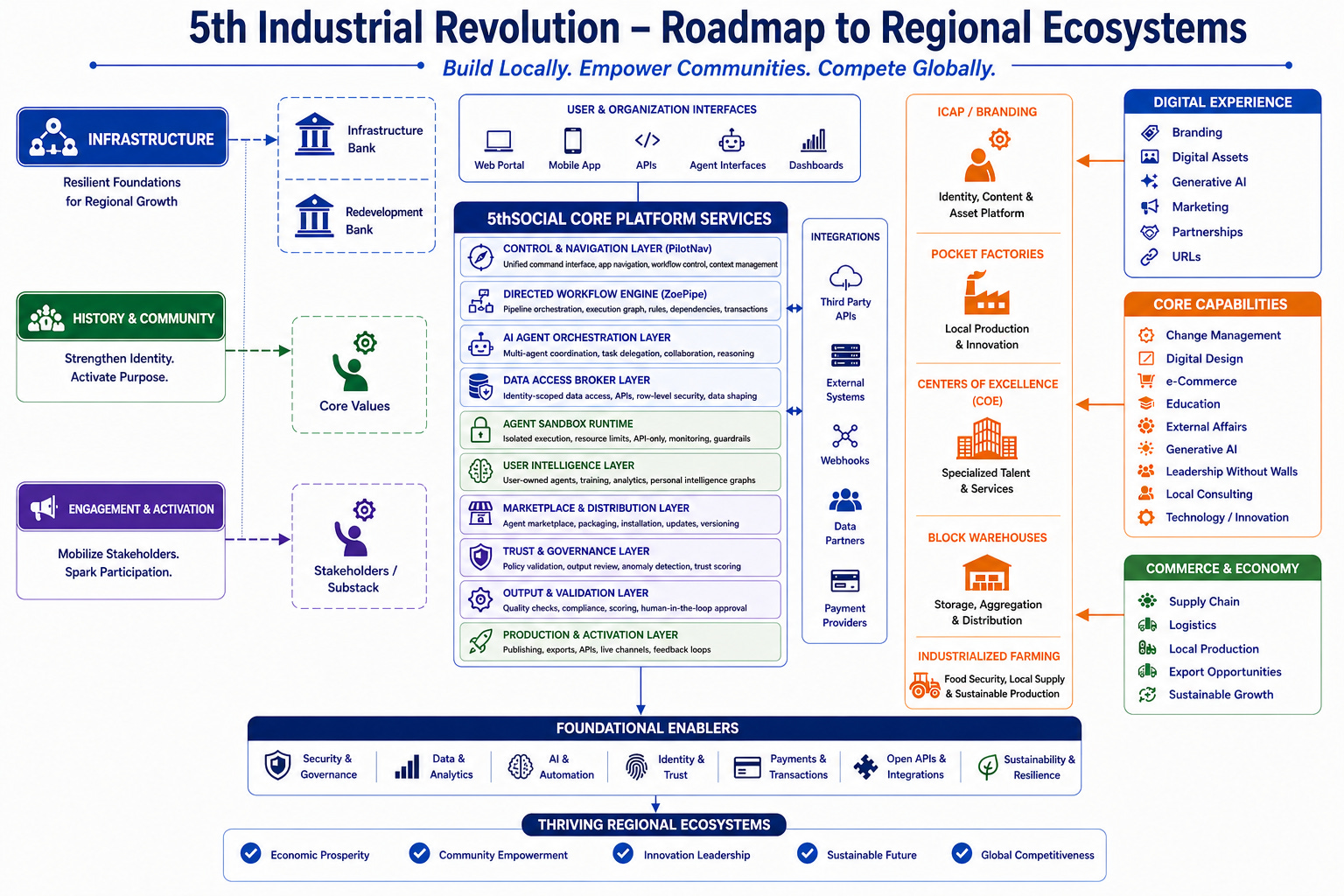
This model introduces a coordinated system where social infrastructure, AI-driven execution, and regional production operate together. Instead of fragmented tools and disconnected institutions, the system aligns participation, workflows, and economic output into a single operating model.
1.3 Objective
Turn community participation into structured execution, and execution into local economic growth.
2. The Core Idea
2.1 System Principle
Most systems fail because they treat people, technology, and production as separate domains. This model treats them as interdependent components of a single system.
2.2 Integrated Domains
People (identity, participation, trust)
Systems (platform orchestration, data, AI)
Production (goods, services, infrastructure)
Commerce (distribution, transactions, growth)
2.3 Key Shift
Engagement is not the end—it is the beginning of execution.
3. System Architecture Overview
Purpose: Provide a structural view of how the system is organized and how inputs are transformed into outputs through coordinated execution.
3.1 Structural Zones
Inputs (community and infrastructure)
Core Execution (platform services)
Outputs (production and economy)
3.2 Flow Principle
Each zone is connected through structured workflows and feedback loops.
4. Input Layers
Purpose: Describe how real-world signals, identity, and capital enter the system and initiate execution.
4.1 Infrastructure
Provides capital and physical foundation through infrastructure banks, redevelopment banks, and regional funding systems.
4.2 History & Community
Defines identity, values, and purpose, ensuring alignment with real-world needs.
4.3 Engagement & Activation
Captures participation and converts it into signals that drive system workflows.
5. 5thSocial Core Platform Services
Purpose: Explain the execution engine that transforms signals into structured workflows, coordinated actions, and validated outputs.
5.1 Role of the Core Layer
The execution engine that converts signals into outcomes.
5.2 Control & Navigation Layer
Manages user interaction, routing, and workflow coordination.
5.3 Directed Workflow Engine
Executes structured, deterministic pipelines with defined dependencies.
5.4 AI Agent Orchestration
Coordinates multiple agents to perform specialized tasks and produce layered intelligence.
5.5 Data Access Broker
Enforces identity-scoped access and secure data interaction.
5.6 Agent Sandbox Runtime
Provides controlled execution environments for safe agent operation.
5.7 User Intelligence Layer
Allows users to create, train, and operate their own AI-driven intelligence systems.
5.8 Marketplace & Distribution
Enables packaging and reuse of agents and workflows.
5.9 Trust & Governance
Validates outputs and enforces compliance.
5.10 Output & Validation
Ensures quality, completeness, and alignment.
5.11 Production & Activation
Publishes outputs and connects them to real-world execution.
6. Digital & Production Layer
Purpose: Describe how system outputs are converted into real-world capabilities, assets, and economic activity.
6.1 Digital Experience
Transforms outputs into branding, content, and partnerships.
6.2 Core Capabilities
Includes design, education, consulting, and innovation capacity.
6.3 Production Systems
Pocket Factories (local production)
Centers of Excellence (specialized expertise)
Block Warehouses (distribution)
Industrialized Farming (supply systems)
6.4 Commerce & Economy
Captures value through supply chain, logistics, and production output.
7. Foundational Enablers
Purpose: Define the underlying systems that ensure scalability, security, and operational integrity across the entire model.
7.1 Core Enablers
Security, data systems, AI orchestration, identity, payments, integrations, and sustainability form the base layer enabling scale and reliability.
8. Closed-Loop System
Purpose: Explain how the system sustains itself through continuous feedback, learning, and economic reinforcement.
8.1 Execution Cycle
Communities engage
Signals are captured
Workflows execute
Outputs are produced
Production systems act
Commerce generates value
Data feeds back into the system
8.2 System Behavior
This creates a compounding system of continuous improvement.
9. Key Innovation
Purpose: Highlight the unique structural advantage of integrating multiple domains into a single coordinated system.
9.1 Integration Model
The integration of social infrastructure, AI execution, governed data systems, production, and economic feedback into a single coordinated architecture.
10. Outcomes
Purpose: Define the measurable results and impact generated by the system when deployed effectively.
10.1 Expected Results
Economic growth
Community empowerment
Innovation leadership
Sustainable development
Global competitiveness
11. Conclusion
Purpose: Reinforce the system’s role as a new operating model for economic development and coordinated execution.
11.1 Final Position
This model transforms fragmented systems into a unified framework where communities generate, execute, and capture value.
11.2 Operating Model
It defines a new economic operating model for the next era: local, structured, and scalable.