

The economic model that shaped the modern firm is breaking in specific, high-impact areas. For decades, companies created value by centralizing coordination—bringing together people, inventory, distribution, and knowledge under one structure. That made sense when coordination was expensive.
In 2026, that assumption no longer holds across many industries.
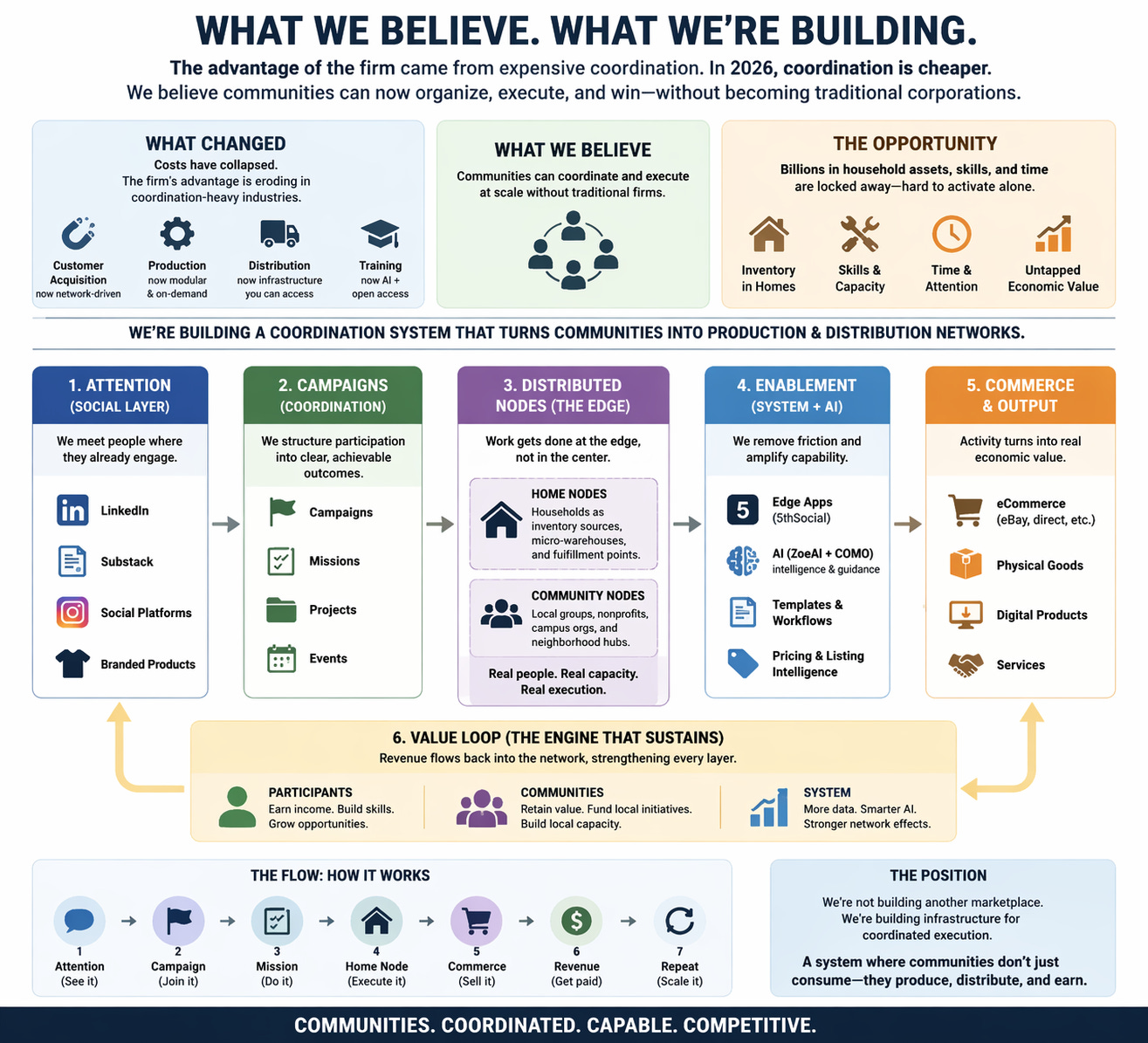
Customer acquisition is now network-driven. Production is modular. Distribution is available as infrastructure. Training is accessible through AI and open systems. The cost of coordinating work has dropped sharply—and with it, the advantage of centralizing everything inside a firm.
We believe this shift opens the door to a new model:
Communities can now coordinate and execute work at scale—without becoming traditional corporations.
This is not a theory about replacing all firms. Many industries will remain centralized. But in coordination-heavy, digital-first sectors—commerce, media, education, and services—the structure is changing.
The opportunity is not to build another platform or marketplace.
The opportunity is to build a coordination system.
What We’re Building
We are building a system that organizes communities into distributed production and distribution networks.
At the center is a simple idea:
Households, communities, and individuals already possess inventory, skills, and capacity. What’s missing is a system to coordinate and activate them.
Our model turns:
Homes into micro distribution nodes
Participants into operators
Campaigns into structured execution systems
AI into the coordination engine
Instead of requiring centralized warehouses, teams, and capital, the system enables:
Inventory to originate from households
Work to be executed through missions
Coordination to happen through campaigns
Distribution to occur at the edge
This is not resale. It is not gig work. It is not social media.
It is a structured system where communities:
Acquire customers
Execute work
Distribute goods
Generate income
Build repeatable capability
How It Works
Attention drives entry (social layer)
Campaigns structure participation
Missions define execution
Households act as nodes
Commerce converts activity into revenue
Value flows back to participants and communities
This creates a closed loop where coordination, production, and distribution are no longer centralized—they are organized.
Why It Matters
The middle class already owns significant untapped assets—physical items, skills, and time. Today, those assets sit idle because activating them individually is too complex.
By reducing coordination cost and organizing participation, we unlock:
New income streams
Local economic activity
Practical skill development
Scalable community-driven commerce
This is not about disruption for its own sake.
It is about building a system that allows people to participate directly in modern economic activity—without needing to plug into traditional corporate structures.
The Position
,At 5thSocial, we’re not building another marketplace.
We are building infrastructure for coordinated execution.
A system where communities don’t just consume—they produce, distribute, and earn.
That is the foundation of the next phase of economic organization.