

Session Length: 30 minutes
Format: Guided lesson + discussion
Audience: Students, workers, builders, and community leaders
Outcome: You understand what the 5th Industrial Revolution is and how communities can create their own jobs and become more self-sustaining.
Overview
The 5th Industrial Revolution is a new stage of change in how people work, build, and earn money.
It is not just about new technology. It is about who owns the tools and who keeps the value that is created.
In the past, big companies and digital platforms controlled most of the system. Communities did the work, but much of the value left the community.
Now the shift is this:
Communities can organize, build, and keep more of the value they create.
That changes the game for the middle class.
5thSocial was designed as a 5th Industrial Revolution solution.
It gives communities three connected spaces to collaborate:
Followers to share ideas and build attention
Friends to organize real work and build new businesses
Connections to form partnerships and grow professional opportunity
Together, these apps help people move from ideas → teamwork → income pathways. They are tools for rebuilding communities through coordination, shared effort, and local value creation.
Learning Objectives
By the end of this session, you will be able to:
Explain what the 5th Industrial Revolution means in simple terms.
Describe how it is different from earlier industrial revolutions.
Understand why many middle-class communities lost stability.
Explain how communities can rebuild economic strength.
Identify ways to design local job and income pathways.
Module 1 — The First Four Industrial Revolutions (Background)
Each industrial revolution changed how people worked and earned income.
1st Industrial Revolution — Machines powered by steam
Shift: Hand labor → Machine help
2nd Industrial Revolution — Factories and electricity
Shift: Small shops → Mass production
3rd Industrial Revolution — Computers and automation
Shift: Paper systems → Digital systems
4th Industrial Revolution — AI and large digital platforms
Shift: Independent businesses → Platform control
Important idea:
The 3rd and 4th revolutions increased speed and efficiency. But they also gave more control to large platforms. Communities worked inside systems they did not own.
Module 2 — What Happened to the Middle Class?
Over time, many communities faced:
Slow wage growth
Jobs moving away
Dependence on big platforms
Less local ownership
Communities created talent and activity. But much of the money flowed outward.
Productivity grew. Local control shrank.
Module 3 — What Makes the 5th Industrial Revolution Different?
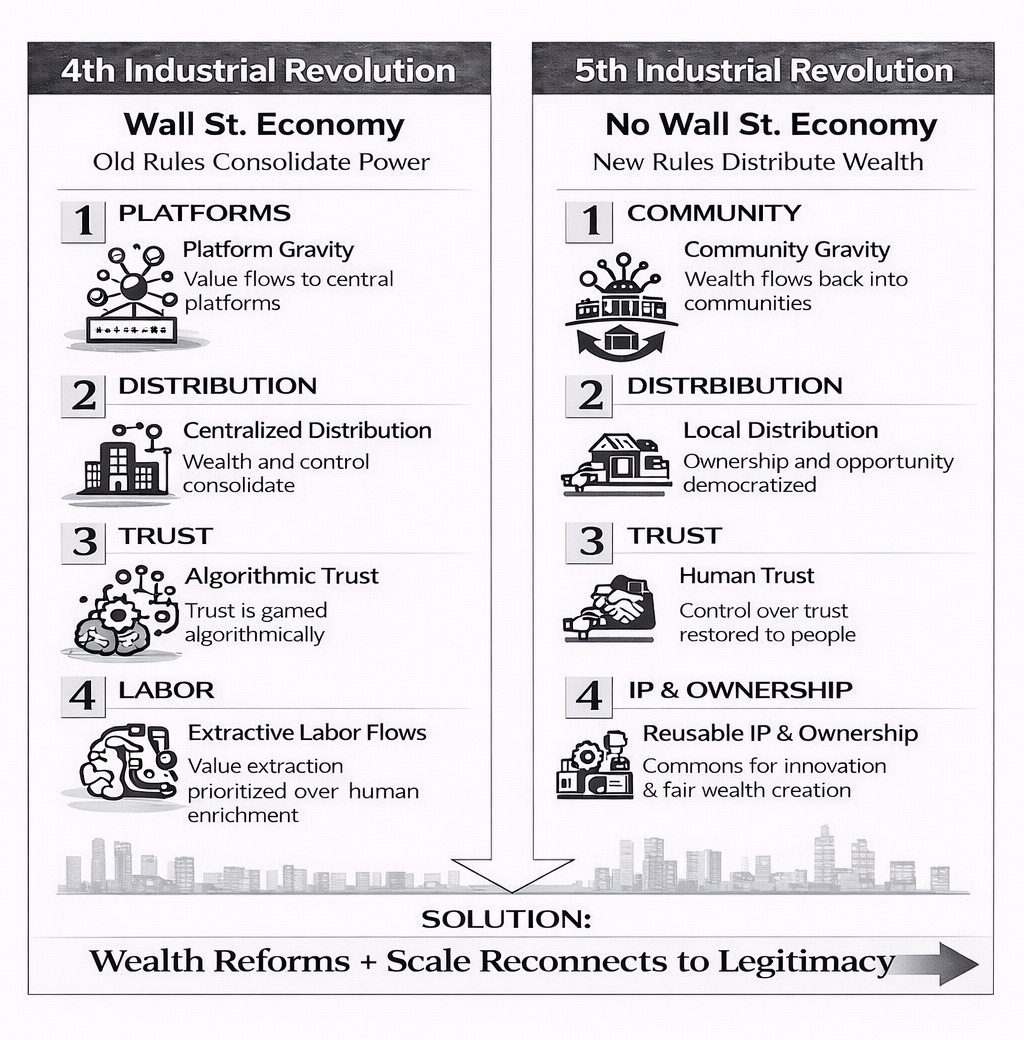
The 5th Industrial Revolution focuses on people and communities.
It supports:
Shared ownership
Local coordination
Using AI as a tool (not a replacement)
Building digital systems that communities can guide
The big change:
Communities can organize online, build projects together, and keep more of the value they create.
Instead of just working inside someone else’s system, they can help design their own.
Module 4 — Where 5thSocial Fits In
5thSocial is built as a 5th Industrial Revolution solution.
It is not just another social app. It is a system designed to help communities organize, build projects, and create economic opportunity together.
With 5thSocial, communities can:
Share ideas publicly (Followers)
Organize real work (Friends)
Build professional partnerships (Connections)
Instead of feeding value into one large platform, people can coordinate, launch initiatives, and keep more of the value inside their community.
5thSocial gives structure, training, and tools so people can turn attention into action and action into income pathways.
This is what a 5th Industrial Revolution system looks like in practice.
Module 5 — Platforms vs Ecosystems
A platform model usually means:
One company controls the system
Users depend on that system
Most value flows upward to the platform
An ecosystem model means:
Many people participate
Work is coordinated
Value moves through the community
Ownership can be shared
In a platform model, you feed the system.
In an ecosystem model, you help build the system.
Module 6 — What Changes for Communities?
Instead of only:
Competing for jobs
Waiting for companies to invest
Relying on outside approval
Communities can:
Organize local projects
Build cooperative businesses
Train members together
Launch shared economic initiatives
Keep more revenue circulating locally
Jobs do not always have to come from outside.
They can be designed and built inside the community.
Self-sustaining communities become possible when training, coordination, and shared ownership work together.
Module 7 — Practical Questions
Ask yourself:
What systems does my community depend on?
What skills and assets do we already have?
Where can we organize instead of compete alone?
What small industry could we build together?
Examples:
Creators forming a shared media network
Local businesses sharing tools and marketing
Skilled workers forming a cooperative service group
Universities supporting regional innovation
When people coordinate, small efforts become real industries.
Module 8 — Risks and Reality
This change does not happen automatically.
Risks include:
Relying too much on technology
Failing to coordinate clearly
Lacking leadership
Confusing visibility with ownership
Building a self-sustaining system requires:
Clear structure
Shared goals
Ongoing training
Trust
Opportunity exists, but it must be organized.
Certification Checkpoint
You should be able to answer:
What makes the 5th Industrial Revolution different from the 4th?
Why did many communities lose economic control?
What is the difference between a platform and an ecosystem?
How can a community design its own job pathways?
Simple understanding:
The 5th Industrial Revolution helps communities organize, build local systems, and keep more of the value they create.
Final Assessment Quiz
Section 1 — Multiple Choice
One major problem of the 4th Industrial Revolution was:
A. No technology
B. Too much local ownership
C. Platform control and dependency
D. No digital toolsThe 5th Industrial Revolution focuses on:
A. Replacing people with machines
B. Community coordination and shared ownership
C. Eliminating digital tools
D. Ending all platformsIn a healthy ecosystem, value mostly:
A. Leaves the community
B. Stays and circulates locally
C. Goes to one central company
D. Disappears
Section 2 — Short Answer
Explain the difference between a platform model and an ecosystem model.
Describe one way a community could create its own job pathway.
Closing Summary
Industrial revolutions change how people gain power and earn income.
The 5th Industrial Revolution gives communities a chance to organize, build together, and keep more of what they create.
Instead of waiting for opportunity, communities can design it.
Structure creates strength.