
From Hand Scans to a Registered Brand: A 10-Year Journey
10 years of experimenting to figure out how historical assets could become something entirely new.

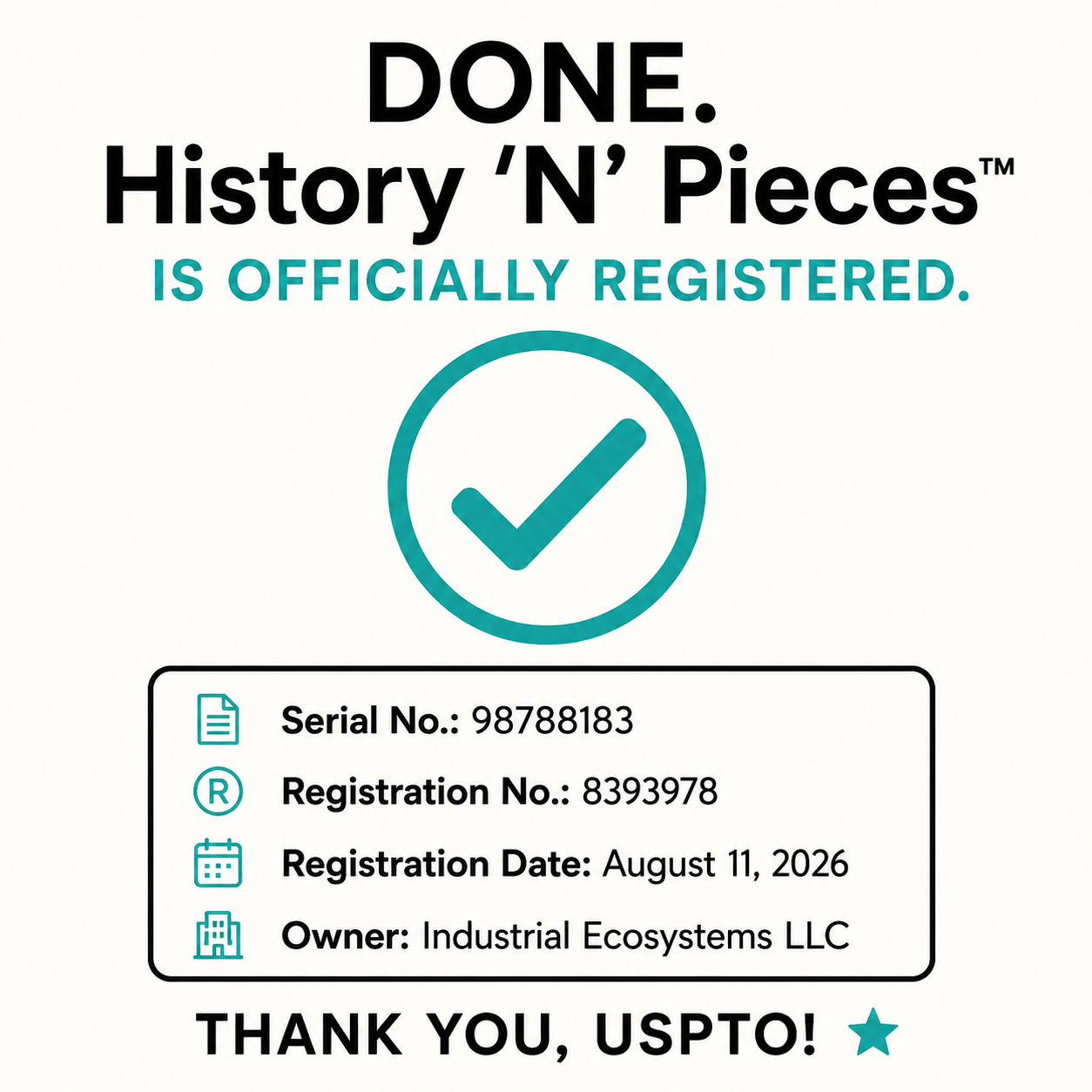
Today, August 11, 2026, History ’N’ Pieces® officially became a federally registered trademark.
That milestone means more to me than simply getting a registration number from the USPTO.
It represents more than 10 years of experimenting, learning, failing, rebuilding, manufacturing and figuring out how historical assets could become something entirely new.
And we started about as low-tech as you can get.
2015: We Started With a Scanner
Back in 2015, we began collecting pieces of American history and scanning them one at a time, by hand.
Old photographs. Postcards. Newspapers. Documents. Advertising. Maps. Tickets. Political material. Local memorabilia.
At the time, we weren’t building an NFT collection. We weren’t building blockchain technology. We weren’t building an AI platform.
We were learning something much more fundamental:
How do you turn thousands of physical pieces of history into digital assets?
Scanning was only the first problem.
You had to identify the item. Organize it. Store it. Describe it. Connect it to a place. Connect it to a period in history. Preserve the original image. Create usable derivatives.
We were effectively learning digital manufacturing before we called it that.
And doing it manually taught us something important: if this was ever going to become large, the process would have to be automated.
2021: We Put History on the Blockchain
Six years later, we ran another experiment.
We took the work and created American Curio Cards, putting 40 state-based digital historical compositions onto Ethereum.
Those assets are still sitting there today.
The American Curio Cards collection on OpenSea shows 40 unique Ethereum assets launched in November 2021. (OpenSea)
Look at them.
They aren’t AI-generated images.
Each composition represents large numbers of individual historical objects that had been digitized, organized and assembled into a new digital artifact.
The blockchain wasn’t the destination.
It was another manufacturing experiment.
Could historical material become a unique digital object? Could provenance become part of the asset? Could physical history have a digital counterpart? Could we create collections representing states and communities?
We learned a lot.
2026: Now We’re Learning to Manufacture at Scale
Fast-forward another five years.
Today we aren’t thinking about creating 40 digital assets.
We’re thinking about manufacturing thousands and eventually millions of historical assets.
That’s a completely different problem.
The scanner taught us digitization.
American Curio Cards taught us digital ownership and provenance.
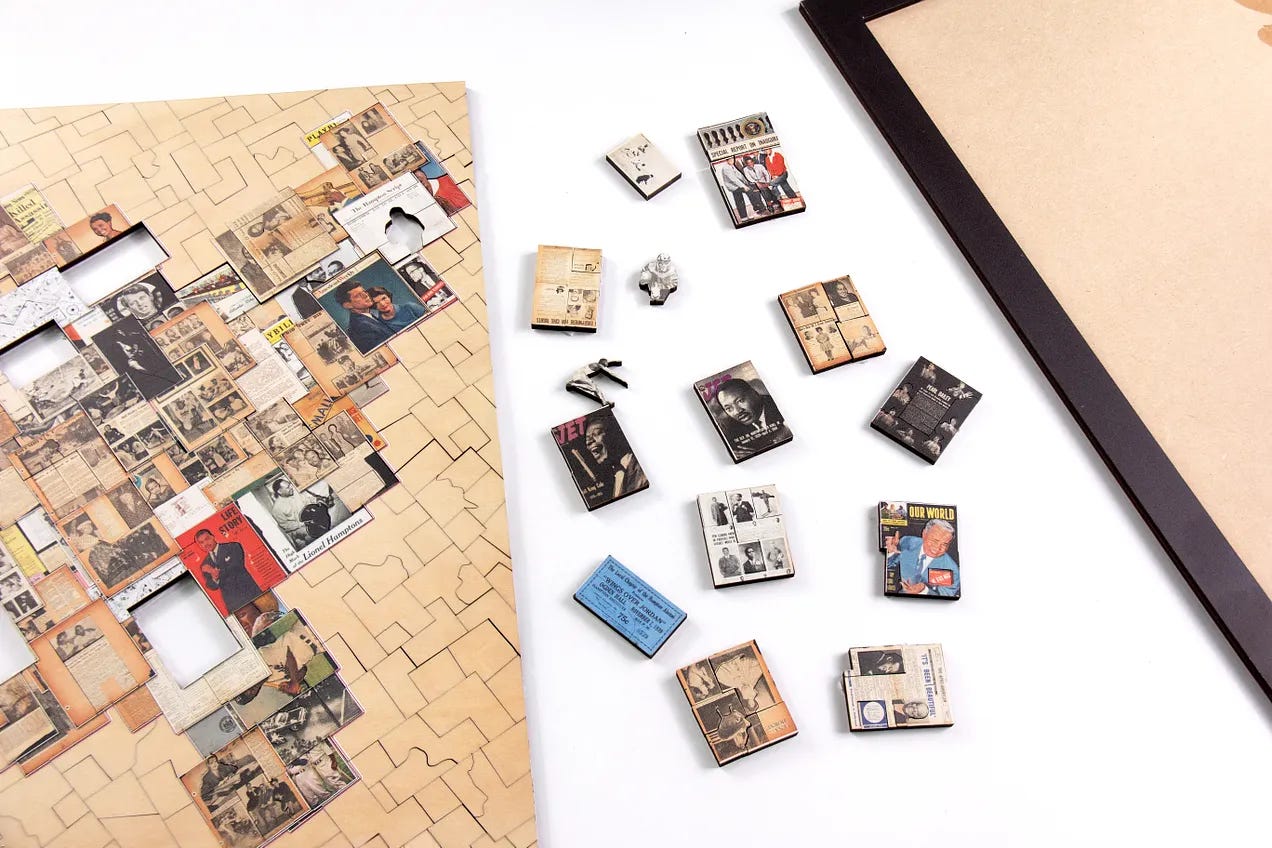
History ’N’ Pieces® taught us physical manufacturing, packaging, distribution and product economics.
AI changes the equation again.
Processes that once required people to inspect, classify, describe and organize every historical object can increasingly become AI-assisted manufacturing workflows.
That creates the possibility of something much larger:
A digital manufacturing system for history.
A photograph isn’t simply a photograph anymore.
It can become structured data, educational content, a puzzle component, a digital collectible, a community story, an exhibit, a research asset, a social post or part of an entirely new product.
One source object can generate many products.
The Journey Is the Asset
There is a tendency in technology to focus on the newest thing.
I think that’s a mistake.
Our advantage isn’t that we discovered AI in 2026.
It’s that we’ve been working on the underlying problem since 2015.
Hand scanning taught us the raw material.
Blockchain taught us digital assets.
Physical products taught us manufacturing.
5thSocial and AI are teaching us orchestration and scale.
And now History ’N’ Pieces® is officially registered.
Registration No. 8393978.
The next chapter isn’t about scanning history one piece at a time.
It’s about figuring out how to manufacture history at digital scale — while keeping the communities, stories and people behind those pieces connected to what we create.
That’s what we’ve actually been building toward for more than a decade.