
5thSocial Beta Planning & Strategy
A controlled validation of the multi-application operating system

Overview
This beta is a controlled validation of the 5thSocial multi-application operating system. It is not a growth event. It is a systems discipline exercise across architecture, behavior, economics, and governance. Every expansion decision is earned through measured stability.
The beta tests five layers simultaneously:
Infrastructure durability
Graph separation discipline
Workflow and agent usability
Regional ecosystem symmetry
Earned income mechanics
Scale only occurs after structural proof.
1. Beta Objectives
Primary Objectives
Validate tenant architecture under real users
Confirm clean separation of Friends, Followers, and Connections graphs
Test structured workflow creation and execution
Verify agent usability without engineering intervention
Validate regional balance across canonical 4-region model
Introduce economic friction via verification gate
Test earned income mechanics under nonprofit allocation model
Non-Objectives
Viral growth
Mass marketing
Feature expansion
UI experimentation at scale
This phase is about discipline, not excitement.
2. Canonical 4-Region Model (Locked Structural Layer)
The 4-Region model is a permanent structural layer of the ecosystem. All cohort distribution, revenue tagging, governance modeling, and reporting are aligned to this structure.
Region 1 — Northeast
ME, VT, NH, MA, CT, RI, NY, PA, NJ, DE, MD, DC, VA, WV, KY, OH
Region 2 — South
NC, SC, GA, FL, TN, AL, MS, LA, AR, OK, TX
Region 3 — Midwest
ND, SD, NE, KS, MN, IA, MO, WI, IL, IN, MI
Region 4 — West
WA, OR, CA, ID, MT, WY, NV, UT, CO, AZ, NM, AK, HI
3. Cohort Structure
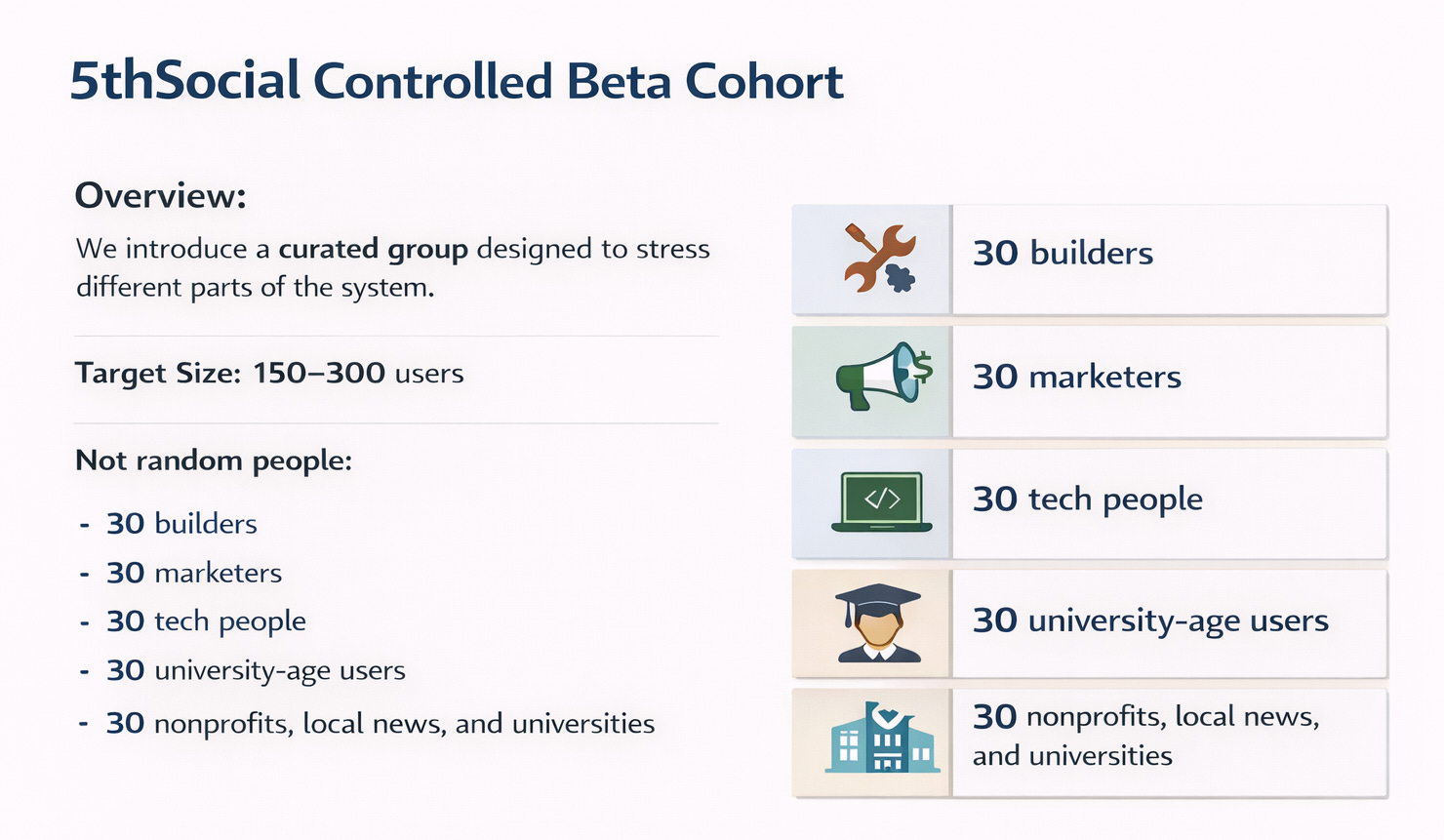
Phase 2A — Stability Cohort
Total: 200 users
50 per region
Purpose:
Balanced geographic load
Cross-region workflow interaction
Regional governance modeling
Behavior symmetry testing
Expansion blocked until checkpoint criteria met.
Stability Checkpoint Requirements
≥60% 14-day retention
No required schema refactor
No unresolved production incidents
Agent workflows usable independently
Regional participation balanced
If unmet → Hold → Fix → Retest
Phase 2B — Expansion Cohort
Total: 300 users
75 per region
Add 25 per region simultaneously.
No asymmetrical scaling.
4. Verification Strategy (Economic Friction)
After joining the waitlist and receiving introduction materials, verification occurs through a $2.50 eBay purchase of a designated verification item. This transaction unlocks verified entry into the system while filtering out the bots.
Purpose:
Establish verified human identity through transactional validation
Create a traceable anti-bot transaction record tied to account activation
Stress-test automated bot resistance through external payment verification friction
Measured Signals:
Waitlist → purchase conversion
Purchase → onboarding completion
Drop-off between purchase and activation
Regional distribution of verified accounts
If payment disrupts onboarding excessively, the flow is optimized — not removed.
5. Behavioral Validation
We evaluate whether users can:
Understand graph separation
Create structured outputs
Build workflows
Use agents without confusion
Collaborate across regions
Confusion indicates design failure — not user failure.
6. Business Entity Activation
Mid-beta introduction of organization profiles.
Validation Areas:
Person → Organization linkage
Role permissions
Shared workflows
Tenant isolation
No schema rewrites allowed at this stage.
7. Earned Income Testing
Activate revenue pathways in controlled conditions.
Test Areas:
Revenue attribution accuracy
Nonprofit allocation logic (30% model under validation)
Regional distribution symmetry
Reporting clarity
Operational transparency
If allocation creates structural strain, scale pauses.
8. Infrastructure Stress Simulation
Simulated Load Targets:
1,000 concurrent feed pulls
300 media uploads per hour
100 workflow executions per hour
50 agent executions per hour
Database utilization should not sustain beyond 60% CPU under load.
9. Governance & Decision Model
Every phase ends with one of three decisions:
Expand
Hold
Rollback
Expansion requires meeting defined thresholds.
No emotional scaling.
No growth without proof.
10. Beta Exit Criteria
Scale beyond 300 only if:
≥60% retention sustained
Stable feed under 1k concurrency
No structural schema modifications required
Verified users complete workflows independently
Earned income allocation clear and trusted
If these conditions are met, controlled growth begins.
If not, iteration continues inside discipline boundaries.
11. Expansion Gate (200 → 300)
Expansion allowed only if ALL are true:
Retention ≥60%
No required schema refactor
Infrastructure KPIs within tolerance
Earned income allocation functioning without manual intervention
Regional variance ≤10%
If any KPI fails → Expansion paused.